Short answer
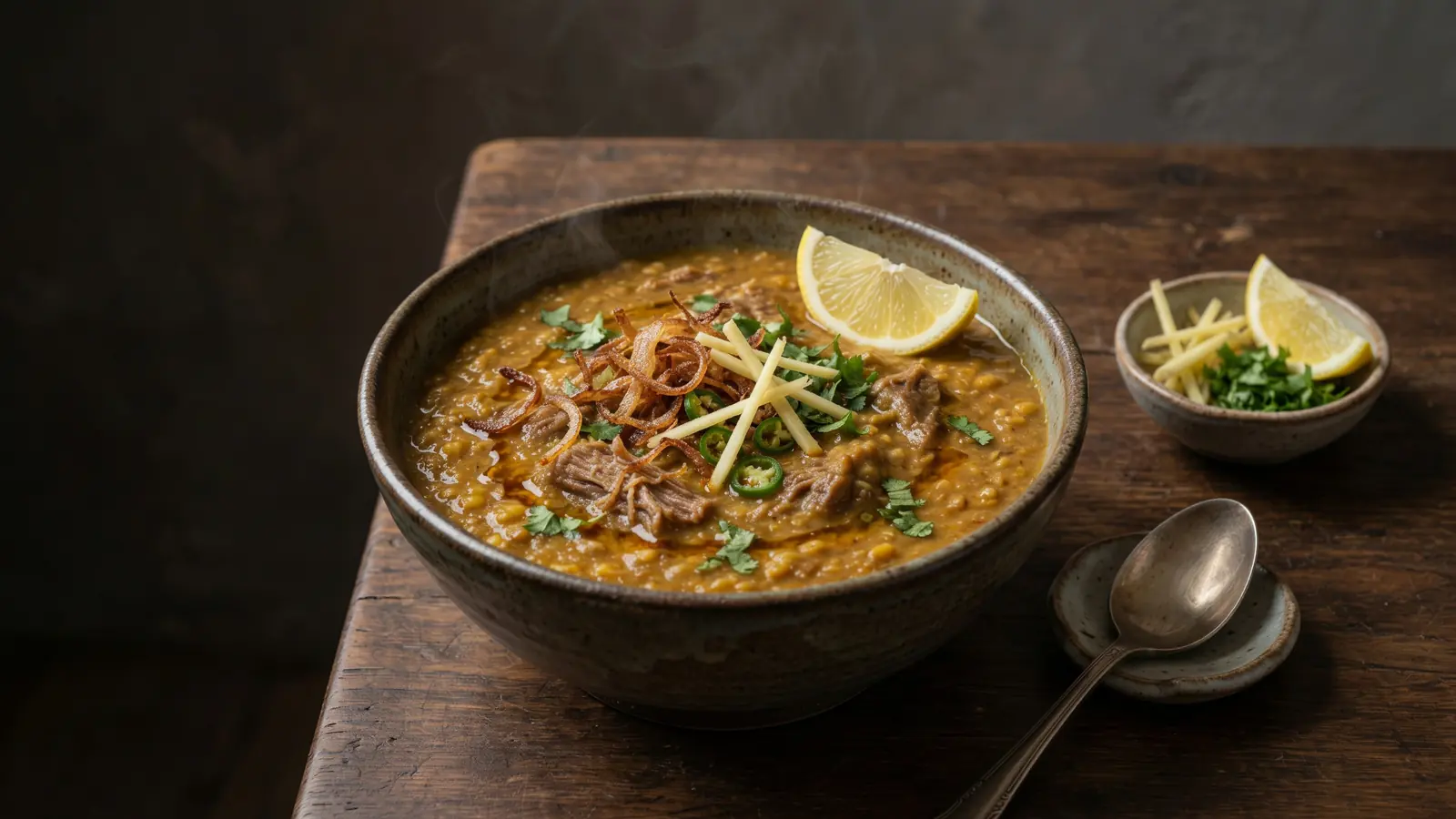
Haleem is a thick porridge of wheat, lentils and meat cooked for hours until it melts into a smooth paste, then topped with fried onions, ginger, lemon and herbs. It is a Hyderabadi favorite, especially during Ramadan, and is eaten as a hearty main dish.
Haleem is an Indian food that is a thick porridge of wheat, lentils and slow-cooked meat, simmered for hours and beaten until smooth. Haleem is best known from Hyderabad, where it is topped with fried onions, ginger, lemon and herbs, and served with flatbread.
What is haleem?
Haleem is a slow-cooked savory porridge made from wheat, lentils and shredded meat with ghee and spices. The ingredients cook down until they form a smooth, stretchy paste, thick enough to be eaten with bread.
The dish has roots in the Arab world, where a similar wheat and meat porridge is called harees, and it spread through the Persian and Mughal kitchens into South Asia. Hyderabad developed its own rich version, often sold in large quantities in the evenings during the month of Ramadan, when many people break their fast. Haleem is also eaten in Pakistan and Bangladesh, with local variations.
What are the ingredients in haleem?
The core ingredients are wheat, lentils, meat, ghee and spices, with fried onions and herbs for finishing. The exact mix of grains and lentils varies from cook to cook.
- Grains: cracked wheat (dalia), whole wheat, sometimes barley or rice.
- Lentils: chana dal, moong dal, masoor dal, urad dal.
- Meat: goat or mutton, beef or chicken.
- Fat and aroma: ghee, fried onions.
- Spices: cardamom, cinnamon, cloves, black pepper, cumin, coriander, red chili, turmeric.
- Garnish: fresh ginger, green chili, mint, coriander leaves, lemon and fried onions.
How is haleem cooked?
Haleem is cooked by simmering wheat, lentils and meat with spices for several hours, then pounding or blending the mixture until smooth. The long cooking breaks the meat into fibers and thickens the porridge.
- Soak the wheat and lentils for several hours or overnight.
- Cook the meat with ginger-garlic paste, onions and spices until it falls off the bone, then shred it.
- Cook the soaked wheat and lentils separately until very soft.
- Combine everything with the meat and its stock and simmer, stirring often.
- Mash, pound or blend the mixture until smooth and stretchy.
- Finish with ghee and simmer briefly.
- Serve topped with fried onions, ginger, mint and lemon.
Traditional haleem makers use large pots and wooden mashers over wood fires, which is how the dish is made in bulk in Hyderabad. At home, a pressure cooker and a hand blender make it manageable.
What is the difference between haleem, harees and khichdi?
Haleem, harees and khichdi are all soft, slow-cooked grain dishes, but they differ in grain, meat and seasoning. Haleem has lentils, meat and many spices, while harees is simpler and khichdi has no pounded meat.
| Dish | Main grains | Meat | Texture | Flavor |
|---|---|---|---|---|
| Haleem | Wheat and lentils | Yes | Smooth, stretchy | Spiced, rich |
| Harees | Wheat | Yes | Thick, mashed | Mild, simple |
| Khichdi | Rice and lentils | Optional | Soft, loose | Gentle |
| Hyderabadi haleem | Wheat, barley, lentils | Goat, beef or chicken | Very smooth | Rich, with garnishes |
Names and recipes overlap across regions, so these distinctions are broad guides.
When and how is haleem eaten?
Haleem is eaten as a main dish, especially in the evening and during Ramadan, with flatbread such as naan. Diners add lemon, fried onions, ginger and green chili at the table.
In Hyderabad it is a seasonal specialty, and many restaurants sell it in large amounts during Ramadan. It is also served at other times of the year in restaurants that specialize in it. Because it is very rich and filling, it is usually served in small bowls.
How do you serve and garnish haleem?
Serve haleem hot in a shallow bowl, topped with fried onions, julienned ginger, chopped mint and coriander, green chili and a squeeze of lemon. A spoonful of ghee can be added on top.
The garnishes cut through the richness and add freshness. Warm naan or any flatbread is the usual accompaniment, and some people like a sprinkle of garam masala or chaat masala as a finish.
Can you make haleem at home?
Yes, haleem can be made at home with a pressure cooker, which cuts the cooking time to one or two hours. A hand blender or a wooden masher replaces the traditional pounding.
- Soak 1 cup of broken wheat and 1/2 cup mixed lentils overnight.
- Pressure cook 1 pound of bone-in goat or beef with onions, ginger-garlic paste and spices until very tender, then shred the meat.
- Cook the wheat and lentils until completely soft.
- Mix the grains, meat and stock and simmer for 30 minutes, stirring often.
- Blend or mash roughly until smooth and stretchy, adding hot water if too thick.
- Finish with ghee and garnishes.
Stir frequently, because haleem sticks to the pot as it thickens.
How is haleem different from a stew or a curry?
Haleem is blended into a smooth paste, whereas a stew or curry keeps pieces of meat and vegetables in a liquid gravy. Haleem is also thicker and is eaten with bread, not rice.
Its main thickener is the wheat and lentil mix, not a sauce base such as tomato or onion gravy. This gives haleem a stretchy texture that is unlike most Indian curries, and it is one reason haleem stays a specialty dish with its own season and its own cooking method.
Is haleem eaten only during Ramadan?
No. Haleem is strongly linked with Ramadan in Hyderabad, but it is also made and eaten at other times of the year, in restaurants and at home. The Ramadan season is simply when demand is highest.
Some places sell it only in that month, while others keep it on the menu year round or only on certain days. Because haleem takes hours to make, restaurants often prepare it in a single large batch, which is why availability can be limited. If you want it, check ahead when it is served.
Is haleem on the Bay Biryanis menu?
Yes, in one form. Bay Biryanis in Austin lists a Goat Haleem among its weekend specials, described on its menu as slow-cooked goat and wheat porridge. Some weekend items are Saturday and Sunday only, so check the ordering page for availability.
The menu page records no price for the Goat Haleem. Check the current price and availability on the restaurant’s ordering page or its official website, baybiryani.com. For the full list, see the menu page here, and for opening times see the hours and location page. This guide is independent and takes no orders.
Common questions
What is haleem made of?
Haleem is made of cracked or whole wheat, lentils such as chana dal and moong dal, meat such as goat, beef or chicken, ghee and whole spices. The mixture is cooked for hours and then beaten until smooth and stretchy.
Is haleem the same as harees?
They are related. Harees is an Arab dish of wheat and meat cooked to a porridge, usually with few spices. Haleem is the South Asian version, with lentils, many spices and rich garnishes. Hyderabadi haleem is its own tradition.
Why is haleem cooked for so long?
The wheat and meat need hours of slow simmering to break down completely into a smooth, thick paste. Long cooking blends the flavors and gives haleem its characteristic stretchy, pulled texture.
What do you eat with haleem?
Haleem is eaten with naan or other flatbread, and topped with fried onions, fresh ginger, green chili, mint, coriander and lemon juice. Some people add a spoonful of ghee on top.
Can you make haleem at home?
Yes, though it takes time. A pressure cooker shortens the cooking to about an hour or two, and a hand blender or masher can replace traditional pounding. Plan to stir often as it thickens.
For the address, opening hours and menu, see Bay Biryanis in Austin.
This article is general information from an independent guide, not from Bay Biryanis itself. For the store’s current details see hours and location.