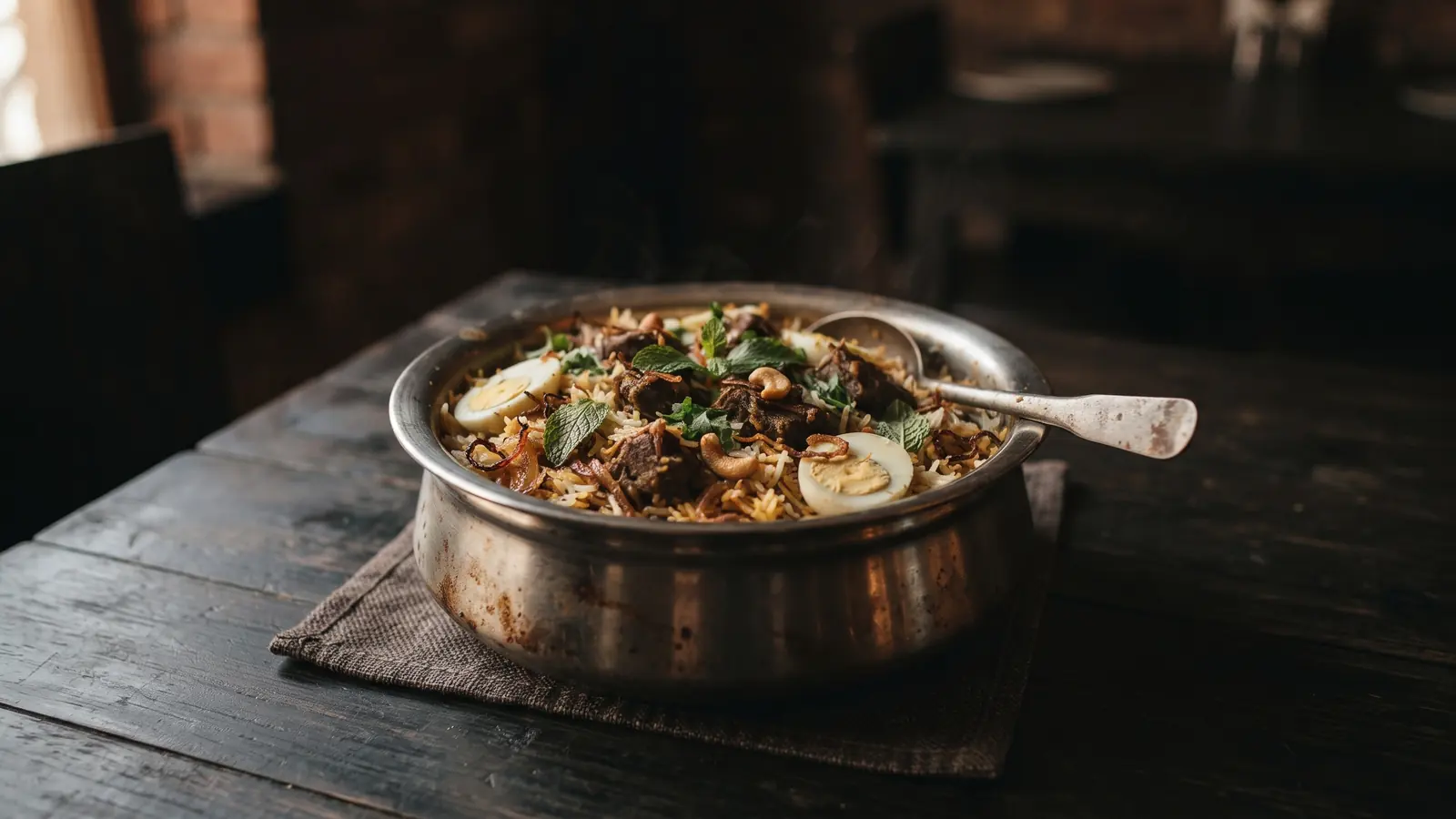
Short answer
A good biryani pot is heavy-bottomed, deep enough for layers of rice and meat, and fitted with a lid that seals steam in. Thick stainless steel or aluminum handis are the most practical choice, and clay suits cooks who want slow, gentle heat.
A biryani pot is a heavy-bottomed, deep pot with a tight-fitting lid, used to cook layered rice and meat by dum, which means slow steaming in a sealed vessel. The best biryani pot for most home cooks is thick stainless steel or aluminum, with clay as a traditional alternative.
What is a biryani pot?
A biryani pot is any wide, deep cooking vessel built to hold layers of rice and meat and to trap steam under a lid. In Indian kitchens it is often called a handi (a round-bellied pot) or a degchi (a lidded pot with a narrower mouth), and in Hyderabad both are common for dum biryani.
Three features matter more than the name: a thick base so heat spreads evenly, enough depth for layers, and a lid that closes tightly. A pot without these will still cook rice, but the bottom layer is more likely to scorch and the top layer more likely to stay hard.
What makes a good pot for dum biryani?
A good pot for dum biryani is heavy, deep, evenly heating and well sealed. Those four qualities protect the rice from burning and keep the steam inside, which is the whole point of dum cooking.
- Heavy base: thin pots create hot spots. A thick base, or a pot set over a flat griddle, keeps heat gentle.
- Depth: layers of marinated meat and parboiled rice need room. Fill the pot no more than about two thirds.
- Lid fit: a lid that sits flat on the rim holds steam. A domed or heavy lid also helps by pressing steam back down.
- Handles: two sturdy side handles are safer than one long handle when the pot is full.
- Surface: a pot that cleans easily after a sticky bottom layer saves effort.
Which material is best: steel, clay, copper-lined or nonstick?
Thick stainless steel or aluminum is the most practical biryani pot material, while clay gives the most traditional result and nonstick is the easiest to clean. The right choice depends on how often you cook biryani and how much care you want to give the pot.
| Material | Heat behavior | Strengths | Watch out for |
|---|---|---|---|
| Heavy stainless steel | Even if the base is thick or layered | Durable, easy to clean, works on any stove | Thin versions scorch rice |
| Heavy aluminum | Spreads heat quickly | Light, common in Indian kitchens | Can dent, reacts with acidic marinades if bare |
| Clay (earthenware) | Slow and gentle | Traditional, moist cooking | Fragile, needs seasoning, not for sudden heat |
| Copper-lined (tin-coated) | Excellent conductor | Classic degchi, looks impressive | Needs relining over time, costly |
| Heavy nonstick | Moderate | Minimal sticking, simple cleaning | Scratches, limited to moderate heat |
A common home choice is a 5 to 6 quart heavy stainless steel or aluminum pot, since it is forgiving and lasts for years.
How big should a biryani pot be?
A pot of 5 to 6 quarts suits a family biryani made with about 2 cups of dry basmati rice and 1.5 to 2 pounds of meat, which serves four to six people. For larger gatherings, a 10 to 12 quart pot handles double the quantity.
These are rough guides, because the rice swells to roughly twice its dry volume and the meat adds bulk. If the pot is too small, steam cannot move through the layers and the top rice stays hard. If it is too large for the amount, the thin layers cook unevenly and dry out. Match the pot to the batch, not to the biggest one you own.
How do you seal a biryani pot for dum?
Sealing a biryani pot means closing the gap between the lid and the rim so steam cannot escape. The classic method uses a rope of wheat dough, and a layer of foil under a heavy lid is the modern shortcut.
- Knead a stiff dough of flour and water and roll it into a long rope.
- Press the rope around the rim of the pot.
- Set the lid on top and press down firmly so the dough forms a seal.
- Place the pot on a heated flat griddle (tawa) over low heat for the dum, usually 20 to 30 minutes.
- Rest the pot off the heat for 10 minutes before breaking the seal.
If you skip dough, cover the pot with a sheet of foil, crimp it around the rim and place the lid on top. A weight on the lid, such as a clean heavy pan, helps keep steam in.
How do you season and care for a biryani pot?
Care depends on the material. Steel and aluminum need only washing with warm water and a soft sponge, while clay needs seasoning before first use and gentle handling afterward.
- Steel and aluminum: soak a stuck bottom layer in warm water before scrubbing. Avoid harsh abrasives that scar the surface.
- Clay: soak the new pot in water for several hours, dry it fully, and warm it slowly on low heat. Never put a cold clay pot on a hot burner.
- Copper-lined: dry it promptly and avoid scraping the lining.
- Nonstick: use wooden or silicone tools and wash by hand.
Do not leave tomato, lemon or tamarind based leftovers sitting in an aluminum or copper-lined pot for long, because acid can mark the metal.
What about a pressure cooker or rice cooker for biryani?
A pressure cooker or rice cooker can make a quick biryani, but neither reproduces true dum. Both cook everything in a closed, wet environment, so the layers blend and the texture is closer to a one-pot rice dish.
True dum biryani keeps meat and rice in separate layers, cooks them partly beforehand and finishes them in gentle steam. A heavy pot with a sealed lid is the right tool for that. A pressure cooker is a reasonable weeknight compromise when time is short.
How does the pot relate to Bay Biryanis?
Bay Biryanis, an Indian restaurant in Austin, Texas, lists its biryanis as cooked on dum on its menu, for example the Hyd Chicken Dum Biryani and the Veg Dum Biryani. The menu does not say what pots or equipment the kitchen uses, so this guide makes no claim about them.
To see the full list of biryanis, open the menu page on this guide, or use the official website, baybiryani.com, or the restaurant’s ordering page. Opening times are on the hours and location page. This site is an independent guide and takes no orders.
Common questions
What size biryani pot do I need for 4 people?
A pot of 5 to 6 quarts suits about 2 cups of dry basmati rice with 1.5 to 2 pounds of meat, which feeds four to six people. The pot should be filled no more than about two thirds so steam can circulate.
Can I make biryani in a regular pot?
Yes, if the pot is heavy-bottomed and the lid fits tightly. Thin pots scorch the bottom layer. Placing the pot on a flat griddle over low heat protects the rice and gives a gentler, more even dum.
How do I seal a biryani pot?
Seal the rim with a rope of kneaded wheat dough pressed between the pot and the lid, or cover the pot with foil under a heavy lid. The seal traps steam so the rice finishes cooking in the meat juices.
Is a nonstick pot good for biryani?
A heavy nonstick pot works for home biryani because the base layer does not stick. Avoid metal tools that scratch it and very high heat. It does not brown or crust the way steel or clay can.
Does a pressure cooker work as a biryani pot?
It can make a quick biryani, but it is not the same as dum. The cooker steams everything together under pressure, so the layers blend and the rice has less separate, fluffy texture than a sealed pot.
Before you go, check the Bay Biryani guide for the current hours and the menu.
This article is general information from an independent guide, not from Bay Biryanis itself. For the store’s current details see hours and location.